

The landscape of value-based care is reaching a pivotal turning point. For years, healthcare leaders have navigated a patchwork of voluntary risk models, pilot programs, and incremental fee-for-service reforms. The Centers for Medicare & Medicaid Services (CMS) is making its strategic direction unmistakably clear: the future of reimbursement lies in mandatory nationwide risk models and continuous, tech-enabled chronic care management.
Two landmark initiatives illustrate this shift: the CJR-X (Comprehensive Care for Joint Replacement Expanded) model and the ACCESS (Advancing Chronic Care with Effective, Scalable Solutions) model. Together, these programs signal a fundamental move away from reactive, visit-based medicine toward proactive, outcome-driven care.
Here’s what healthcare leaders need to know about these new CMS programs - and how organizations can adapt to protect their operational and financial health.
Launching January 1, 2028, CJR-X marks a massive expansion of episode-based payment models. Unlike previous voluntary iterations, CJR-X makes bundled payments for lower extremity joint replacements (LEJR) - including inpatient and outpatient hip, knee, and ankle procedures - mandatory for almost every acute care hospital nationwide.
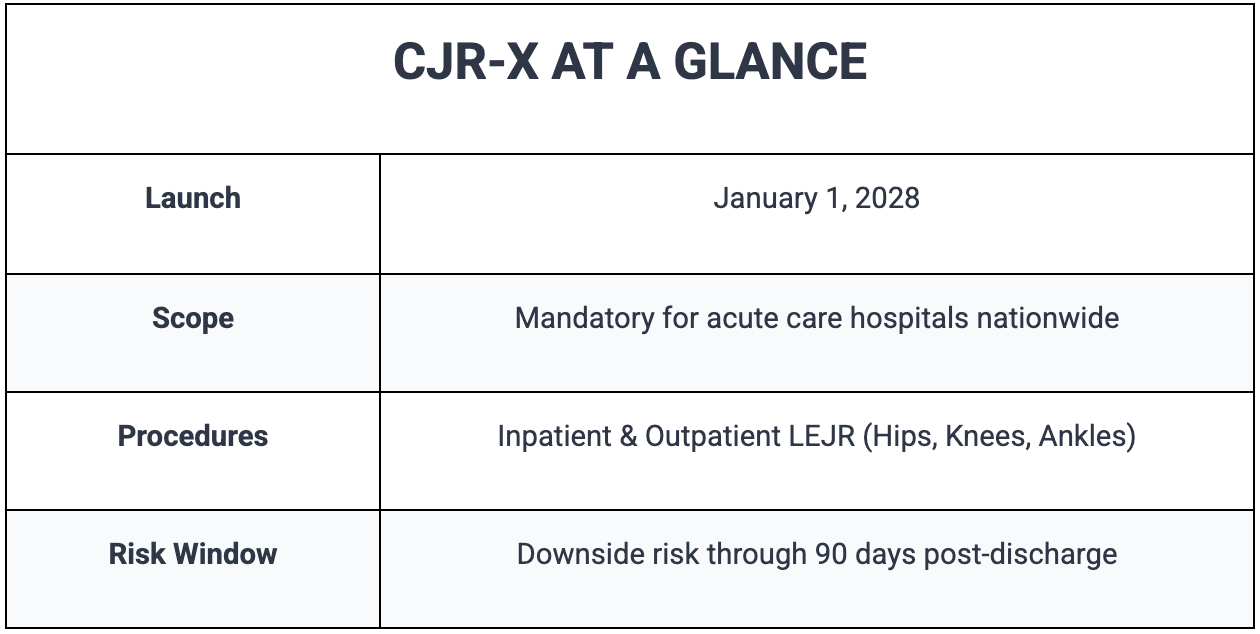
Under CJR-X, participating hospitals assume two-sided financial accountability starting the day of the procedure. Holding hospitals accountable for the total cost and quality of care through a 90-day post-discharge window forces a dramatic rethink of traditional post-acute discharge workflows.
Executive Takeaway: To avoid financial deficits under CJR-X, acute care providers must shift from institutional post-acute care to a proactive, home-first recovery strategy. Keeping patients safely recovering at home while catching surgical or rehab complications early is no longer just a quality goal - it’s a financial imperative.
To succeed under CJR-X, health systems must deploy tools that track post-discharge rehabilitation compliance in real time, and flag recovery risks long before they turn into costly hospital readmissions.
While CJR-X targets acute surgical episodes, the 10-year ACCESS model tackles the ongoing burden of chronic disease management. Replacing traditional visit-based billing with Outcome-Aligned Payments (OAPs), ACCESS fundamentally changes how health systems and digital health organizations manage chronic conditions.
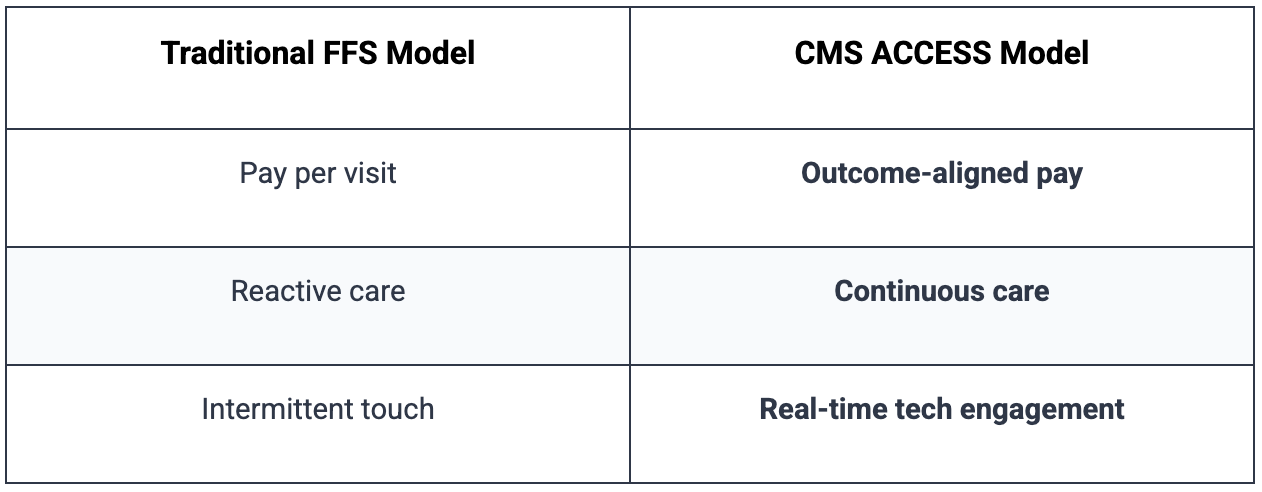
Rather than waiting for a patient to schedule a routine follow-up appointment, ACCESS rewards organizations that leverage digital health tools to maintain continuous, real-time touchpoints. This continuous engagement enables clinical teams to adjust medications, address rising health risks, and keep patients on track between traditional office visits.
Although CJR-X and ACCESS target different clinical areas, they share a core underlying thread: organizations cannot manage outcome-aligned or bundled financial risk without real-time decision support.
Bridging clinical operations with financial risk requires infrastructure that can:
At Radial, we empower health systems and provider organizations to navigate this transition smoothly. By delivering insights and decision support infrastructure, Radial helps clinical teams bridge the gap between day-to-day patient care and complex risk-bearing contracts.
Whether your organization is preparing for the mandatory rollout of CJR-X or optimizing existing workflows to capture revenue opportunities under ACCESS, early preparation is key:
The migration from volume to value is no longer a distant theoretical shift, it is operational reality. Organizations that invest in predictive, tech-enabled care infrastructure today will be best positioned to drive superior patient outcomes and ensure long-term financial sustainability tomorrow.
We believe in the transformative potential of Al—not to replace the decision-making authority of clinical staff, but to empower teams to make optimal decisions faster.
About Radial
Organizations like yours are transforming care with our support. Learn how your business can leverage Radial.
Book A Demo


