

CareMax brings more of the right patients home and cuts readmissions by 25%
CareMax cares for Medicare ACO members in Massachusetts and Florida. With Radial Care flagging, on the first day of a hospital stay, the patients who could safely go home, and a nurse-driven workflow to act on it, more of the right patients went home with home health instead of to a facility, and fewer came back to the hospital.
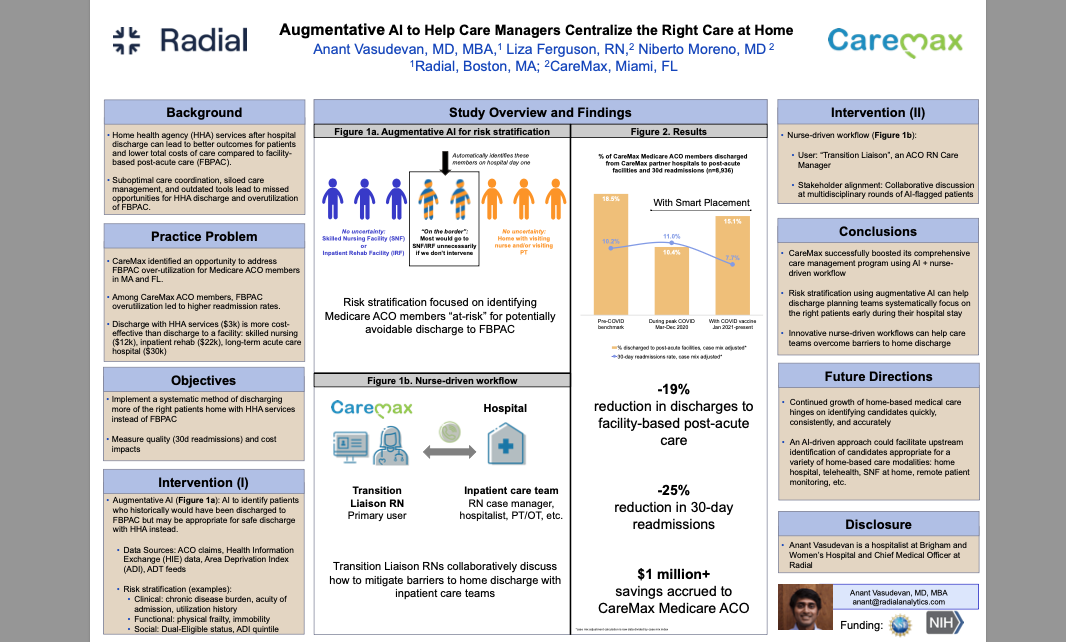
19% fewer discharges to post-acute facilities
25% fewer 30-day readmissions
$1 million+ saved by the CareMax Medicare ACO
The challenge: too many patients leave the hospital for a facility
After a hospital stay, going home with home health services can lead to better outcomes for patients, and lower total costs of care, than a stay in a skilled nursing facility or another post-acute facility. Yet siloed care management, weak care coordination and outdated tools mean many patients who could go home are sent to a facility instead.
CareMax saw this among its Medicare ACO members in Massachusetts and Florida. Too many were discharged to post-acute facilities, and that overuse was driving up readmissions. Every unnecessary facility stay also cost the ACO several times what home health would have.
The question was how to find, early in each hospital stay, the patients who could safely go home, and then make sure they did.
- Home with home health services
- $3,000
- Skilled nursing facility
- $12,000
- Inpatient rehab facility
- $22,000
- Long-term acute care hospital
- $30,000
The solution: AI that finds the patients "on the border" on day one
Most hospitalized patients are easy calls. Radial Care looks for the ones in between, and flags them on their first day in the hospital, while there is still time to plan a discharge home.
Clearly needs a facility
Some patients will need a skilled nursing facility or inpatient rehab whatever happens.
Where Radial Care focuses
On the border
Patients who would usually be discharged to a facility but could go home safely with home health. Without someone stepping in, most of them go to a facility they don't need.
Clearly going home
Some patients will go home with a visiting nurse or physical therapist either way.
What the AI looks at
Radial Care combines ACO claims, health information exchange (HIE) data, hospital admission, discharge and transfer (ADT) feeds and the Area Deprivation Index (ADI) to weigh each patient's risk in three ways.
Clinical
Chronic disease burden, how acute the admission is, and the patient's history of hospital and facility use.
Functional
Physical frailty and immobility.
Social
Dual eligibility for Medicare and Medicaid, and how deprived the patient's neighborhood is.
In practice: a nurse-driven workflow
CareMax built the workflow around a Transition Liaison, an ACO RN care manager who works alongside each partner hospital's inpatient care team.
- 1
Flag
On hospital day one, Radial Care flags the ACO members at risk of a potentially avoidable discharge to a facility.
- 2
Discuss
The Transition Liaison brings the flagged patients to multidisciplinary rounds with the inpatient team: the RN case manager, hospitalist, and physical and occupational therapists.
- 3
Clear the way home
Together they work through the barriers to a home discharge and line up home health services, such as a visiting nurse or physical therapist.
The results
With Radial Care, discharges to post-acute facilities fell by 19% and 30-day readmissions by 25%, and the CareMax Medicare ACO saved more than $1 million.
The study followed 8,936 CareMax Medicare ACO members discharged from CareMax partner hospitals. Facility discharges fell sharply in the early months of COVID, when hospitals widely avoided sending patients to facilities. As facilities reopened, the rate rose again but stayed well below the pre-COVID benchmark, while readmissions fell to 7.7%.
| Period | Discharged to a post-acute facility | 30-day readmissions |
|---|---|---|
| Pre-COVID benchmark | 18.5% | 10.2% |
| Peak COVID, March to December 2020, with Radial Care | 10.4% | 11.0% |
| With the COVID vaccine, January 2021 on, with Radial Care | 15.1% | 7.7% |
Rates are adjusted for case mix: the raw rate divided by the case mix index.
What CareMax learned
- AI and a nurse-driven workflow strengthened CareMax's comprehensive care management program.
- Risk stratification with augmentative AI helps discharge planning teams focus on the right patients systematically, early in the hospital stay.
- Nurse-driven workflows help care teams overcome the barriers to a home discharge.
What's next
The growth of home-based medical care depends on finding the right candidates quickly, consistently and accurately. The same AI-driven approach can identify candidates further upstream for a range of home-based care: hospital at home, telehealth, SNF at home and remote patient monitoring.
As presented at the American Academy of Home Care Medicine (AAHCM) 2024 Annual Meeting
Anant Vasudevan, MD, MBA (Radial), with Liza Ferguson, RN, and Bert Moreno, MD (CareMax)
Radial technology development was funded in part by the National Science Foundation and the National Institutes of Health.
A partner, not a portal
Find the patients who could go home, on their first hospital day.
Bring one question about your population. We'll show you the platform on illustrative data, then size the opportunity on yours, with the team who would work beside you.
- A named clinical and technical lead
- Quarterly business reviews
- On-site visits and training