
Beth Israel Lahey Health brings more patients home after a hospital stay
Beth Israel Lahey Health Performance Network (BILHPN) is the clinically integrated network of Beth Israel Lahey Health. With Radial Care flagging, on the first day of a hospital stay, the patients who could safely recover at home, and nurse care managers acting on it with each hospital's team, fewer patients went to facilities they didn't need, hospital stays got shorter, and the savings grew to 7.1 times the fee.
$1.1 million saved in year one, and $1.5 million in the next five months
7.1 times the fee returned in savings in year two
3,400 hospital days avoided per year at BIDMC
The challenge: too many patients recover in a facility they don't need
Seniors are living longer, chronic illness is growing, and population health teams have limited resources. As health systems move from volume to value, more care has to move into the home, and AI can help decide where.
After a hospital stay, many patients are sent to a skilled nursing facility (SNF) or an inpatient rehab facility (IRF) when they could recover at home. For many common conditions, seniors achieve the same or better functional outcomes with home care. Facility stays can even do harm, through infections, delirium and blood clots. Mortality is similar at home and in facilities, readmissions are similar for key groups such as patients with dementia, and costs after discharge are far lower with home health. Home health is the best value, when it is used for the right patients.
- Home health episode
- $3,500
- Skilled nursing facility stay
- $12,000
- Acute inpatient hospital stay
- $16,500
- Inpatient rehab facility stay
- $26,000
Source: BILHPN data and the MedPAC Data Book, July 2024
What BILHPN's own data showed
Beth Israel Lahey Health Performance Network (BILHPN), the clinically integrated network of Beth Israel Lahey Health (BILH), found the same pattern in its own patients. Patients who went home with home health had the shortest hospital stays, and even after adjusting for case mix, patients discharged to a SNF came back to the hospital most often.
| Discharged to | Hospital length of stay (days) | 30-day unplanned readmissions |
|---|---|---|
| Home with home health | 1.8 | 9.6% |
| Skilled nursing facility | 2.9 | 12.3% |
| Inpatient rehab facility | 2.3 | 6.5% |
Both measures are adjusted for case mix. Yet before Radial, most BILH hospitals sent more patients to facilities than they needed to.
Two practices that bring more patients home
Two science-backed practices during the hospital stay make a discharge home more likely.
Early mobilization
Getting patients moving early makes a discharge home more likely, improves recovery and function, lowers the risk of deconditioning, blood clots and pneumonia, and shortens hospital stays and cuts 30-day readmissions.
Discharge planning tailored to each patient
For older patients with at least one other condition, an individual discharge plan shortens hospital stays, reduces readmissions, and improves satisfaction and emotional well-being.
The solution: Radial Care finds the patients "on the border" on day one
The key question was how AI could make these practices work harder. Most hospitalized patients are easy calls. Radial Care looks for the ones in between, and flags them on their first day in the hospital, while there is still time to plan a discharge home.
Clearly needs a facility
Some patients will need a skilled nursing facility or inpatient rehab whatever happens.
Where Radial Care focuses
On the border
Patients at risk of an unnecessary facility stay. Steering them toward home care reduces readmissions, hospital length of stay and the total cost of care.
Clearly going home
Some patients will go home with skilled nursing or physical therapy either way.
In practice: a day-one workflow across the care team
BILHPN built its workflow around a nurse care manager who works with each hospital's care team from the first day of the stay, so that more patients go home: where they prefer to be, and where outcomes are best.
- 1
Flag
The BILHPN nurse care manager uses Radial Care to find the patients "on the border" who could safely skip a SNF or IRF stay in favor of home care.
- 2
Discuss
On the first day of the hospital stay, the care manager talks through Radial Care's insights with the patient's care team.
- 3
Bring it to rounds
The inpatient RN case manager or physical therapist brings those insights to multidisciplinary rounds, where the discharge plan takes shape.
One patient's story at Beth Israel Deaconess
A man in his 90s with heart failure, chronic kidney disease and atrial fibrillation was admitted to Beth Israel Deaconess Medical Center (BIDMC) with a flare of his heart failure.
Hospital day 1
Radial Care flagged him as "on the border": a strong candidate to avoid a facility stay in favor of robust home care. Its insights noted that this stay was a 30-day readmission, so home and wraparound services could lower his risk of another; that his past facility stays had followed more serious diagnoses; and that he had seen a cardiologist twice in the past year, so follow-up after discharge was likely.
Hospital day 4
The BILHPN care manager reached out to the BIDMC care team to plan his discharge together. The team agreed on early mobilization, with a discharge home once his fluid status was stable. On day four he went home with services, and the care manager followed him for 30 days.
After going home
On a follow-up call, the care manager found that he didn't understand why he needed a heart failure clinic visit to check his sodium, and helped him book it. The care manager also noticed a 7 lb weight loss in the week since discharge, asked his primary care physician to order a blood test and review his diuretic dose, and arranged the blood draw at home through the home health agency. His doctor adjusted the dose, and his weight stabilized.
The results
Across BIDMC, Lahey Hospital and Mount Auburn Hospital, Radial Care saved $1.1 million in its first year, 3.4 times the fee paid, and $1.5 million in the first five months of its second year, 7.1 times the fee.
Each hospital had a different main opportunity: BIDMC to avoid unnecessary SNF stays in favor of home care, Lahey to avoid unnecessary IRF stays in favor of a SNF or home care, and Mount Auburn to avoid unnecessary SNF and IRF stays.
| Hospital | Year 1 savings | Year 2 savings, first 5 months |
|---|---|---|
| Beth Israel Deaconess Medical Center | $245,000 | $680,000 |
| Lahey Hospital | $595,000 | $230,000 |
| Mount Auburn Hospital | $255,000 | $545,000 |
Year 1 ran from June 1, 2023, to May 31, 2024, and the first five months of year 2 from June 1 to October 31, 2024.
Fewer facility stays, shorter hospital stays
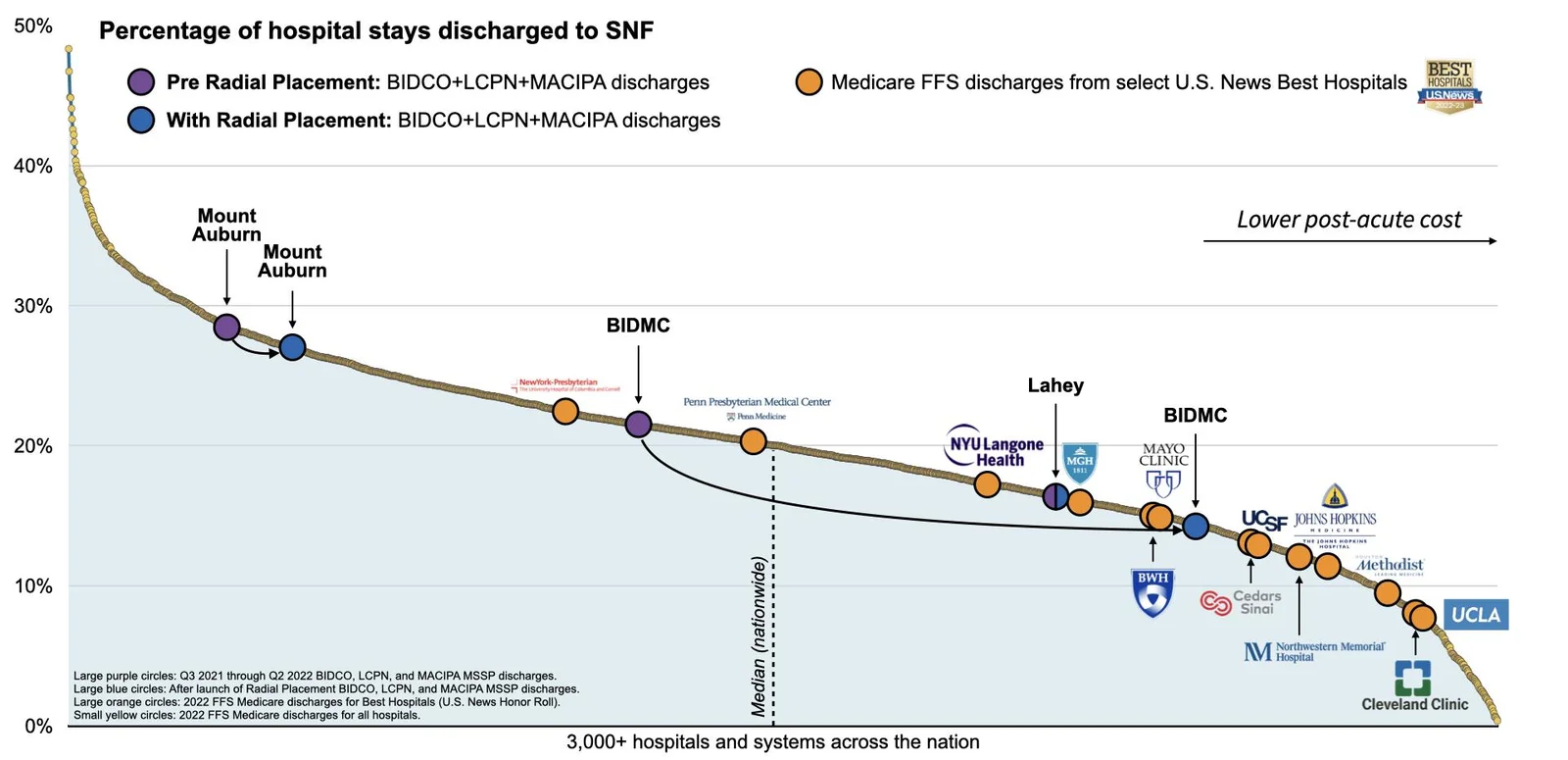
BIDMC's rate of discharges to a SNF fell from more than 20% of hospital stays to under 15%, which now rivals the nation's top hospitals. Mount Auburn's fell too.
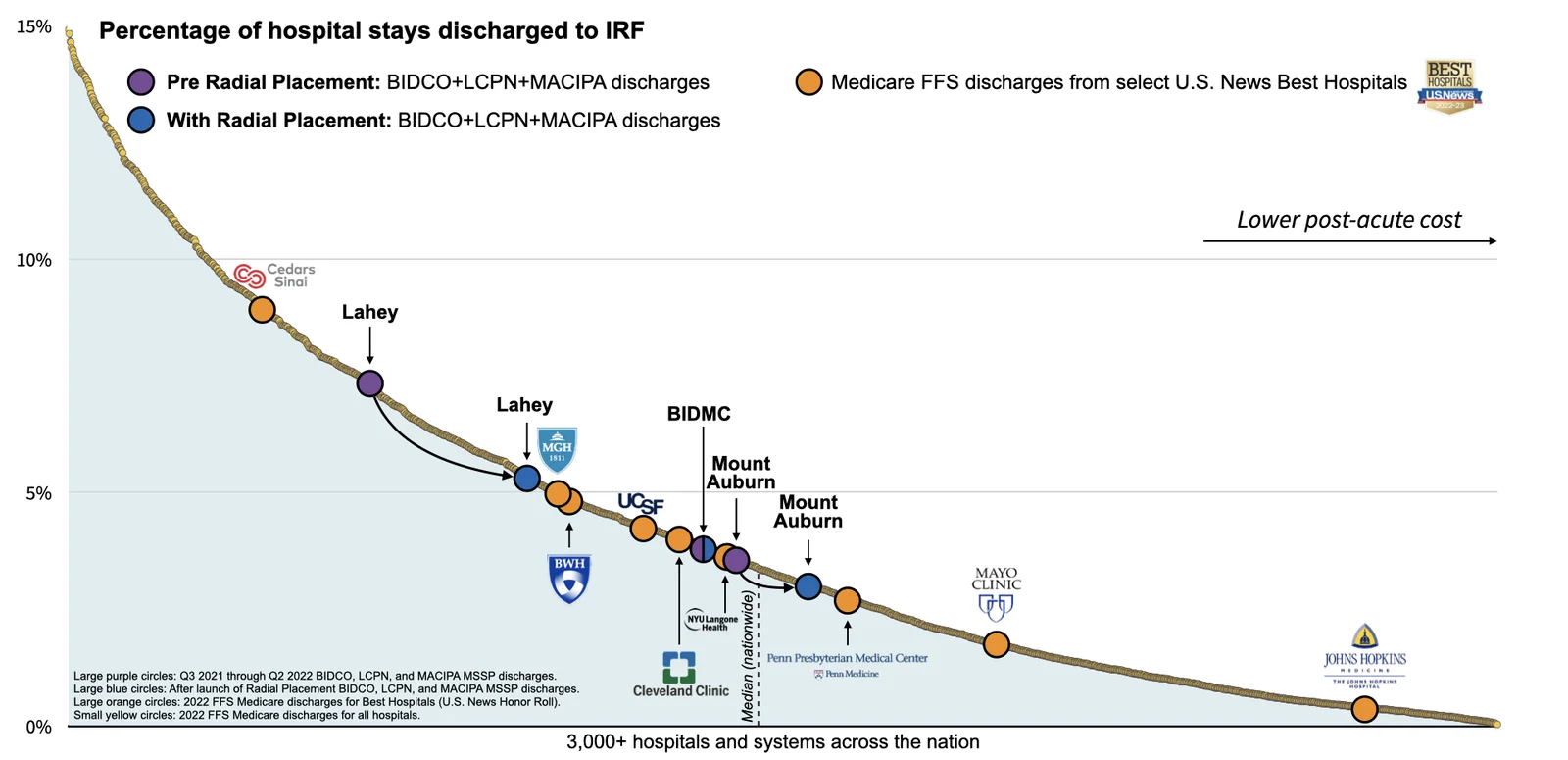
Lahey's rate of discharges to an IRF fell from more than 7% to about 5%, and Mount Auburn's fell too, though there is further opportunity.
At BIDMC, avoiding facility stays also shortened hospital stays for MSSP ACO patients by 14%, or 3,400 hospital days per year, and by 8% after adjusting for case mix.
| Average hospital stay at BIDMC (days) | Before Radial | With Radial, year 1 | With Radial, year 2 |
|---|---|---|---|
| Not adjusted for case mix | 5.72 | 5.25 | 4.94 |
| Adjusted for case mix | 5.72 | 5.57 | 5.28 |
What's next
BILHPN and Radial see room to grow on three fronts.
More areas of impact
End-of-life care, reducing social risk, and getting the most from post-acute care after discharge.
More sites of care
Home-based services, including palliative care, and outpatient and primary care providers.
More populations
CMS's Transforming Episode Accountability Model (TEAM), starting in January 2026, Medicare Advantage and MassHealth.
As presented at HIMSS New England 2025
Roger Schutt, DO (Beth Israel Lahey Health Performance Network), with Anant Vasudevan, MD, MBA, and Kerry Son, MSN, FNP (Radial)
Radial technology development was funded in part by the National Science Foundation and the National Institutes of Health.
A partner, not a portal
Find the patients who could recover at home, on their first hospital day.
Bring one question about your population. We'll show you the platform on illustrative data, then size the opportunity on yours, with the team who would work beside you.
- A named clinical and technical lead
- Quarterly business reviews
- On-site visits and training